
Understanding SEND
Every Child's Journey Is Different
Every child develops and learns in their own way. Sometimes, a child may need additional support with their learning, communication, physical development, emotional wellbeing or participation in school life.
At Bewdley Primary School, we recognise that understanding a child's needs is not always straightforward. We work closely with children, families and other professionals to identify strengths, understand difficulties and consider what support may help. You do not need to wait for a diagnosis before talking to us or before appropriate support can be considered.
What Is SEND?
SEND stands for Special Educational Needs and Disabilities.
A child has special educational needs when they have a learning difficulty or disability that calls for special educational provision — support that is additional to or different from the provision generally made for children of the same age.
Children's needs are commonly considered within four broad areas:
Communication and InteractionThis may include difficulties with speech, language, understanding communication or social interaction. |
Cognition and LearningThis may include difficulties with learning, understanding, remembering or developing particular skills. |
Social, Emotional and Mental HealthThis may include difficulties with emotional regulation, relationships, anxiety or engagement with learning. |
Sensory and/or Physical NeedsThis may include needs relating to hearing, vision, physical development or sensory processing. |
These areas help us understand and plan for children's needs, but they do not define a child. Some children may have needs across more than one area.
What Support Is Ordinarily Available?
You might be surprised by how much support can be provided as part of everyday classroom teaching.
Worcestershire uses the term Ordinarily Available Inclusive Provision to describe a wide range of inclusive approaches, adaptations, resources and strategies that schools and settings are expected to consider and provide according to children's needs.
At Bewdley Primary School, we recognise that children do not all learn or experience school in the same way. Thoughtful adaptations are an important part of effective teaching and inclusion.
For more information about the approaches and support schools are expected to consider, you can explore Worcestershire's guidance on Ordinarily Available Inclusive Provision by clicking on the link below:
Worcestershire: Ordinarily Available Inclusive Provision
What Might This Look Like?
|
Learning and understanding Clear explanations, modelling and examples. Learning broken into manageable steps. Practical equipment and visual resources. Additional opportunities to practise and revisit learning. Adjustments to tasks or how children demonstrate their understanding. |
Communication and organisation Visual timetables and Widgit symbols. Clear, predictable routines. Instructions supported by pictures or demonstrations. Additional processing time where needed. Support with organising tasks and transitions. |
Emotional wellbeing and regulation Positive relationships with trusted adults. Supportive routines and reassurance. Opportunities for movement or short breaks where appropriate. Access to quieter spaces or regulation resources when needed. Help with understanding feelings and managing difficulties. |
Participation and independence Adjustments to classroom activities. Support with friendships and social interaction. Thoughtful planning for playtimes, trips and wider school experiences. Resources or strategies that help children become more independent. |
These are examples, not a checklist. The support a child receives will depend on their individual needs, and not every approach will be appropriate for every child.
A child does not need a diagnosis, an EHCP or a place on the SEND register to benefit from ordinarily available inclusive provision. For some children, these approaches will provide the support they need. Other children may require additional, more personalised provision.
When Might My Child Need SEN Support?
Sometimes, despite appropriate teaching and ordinarily available inclusive provision, a child may continue to experience significant difficulties or require provision that is additional to or different from that generally made for children of the same age.
Where this is the case, we consider whether the child has special educational needs and requires SEN Support. This involves identifying needs, planning suitable provision, involving the child and their family, and reviewing the difference that support is making. Being identified as receiving SEN Support is not dependent on having a medical diagnosis.
I'm Concerned About My Child. What Should I Do?
The best place to start is by talking to your child's class teacher.
You might be concerned about learning, communication, friendships, behaviour, emotional wellbeing or how your child is experiencing school. Your child's teacher can listen to your concerns, explain what they are noticing in school and discuss approaches that may help. Where appropriate, our SENDCo, Jacqui Bennett, can become involved to help consider additional support or advice. You don't need to know whether your child has SEND before starting that conversation. If something is worrying you, please talk to us.
How Do We Identify and Support Needs? 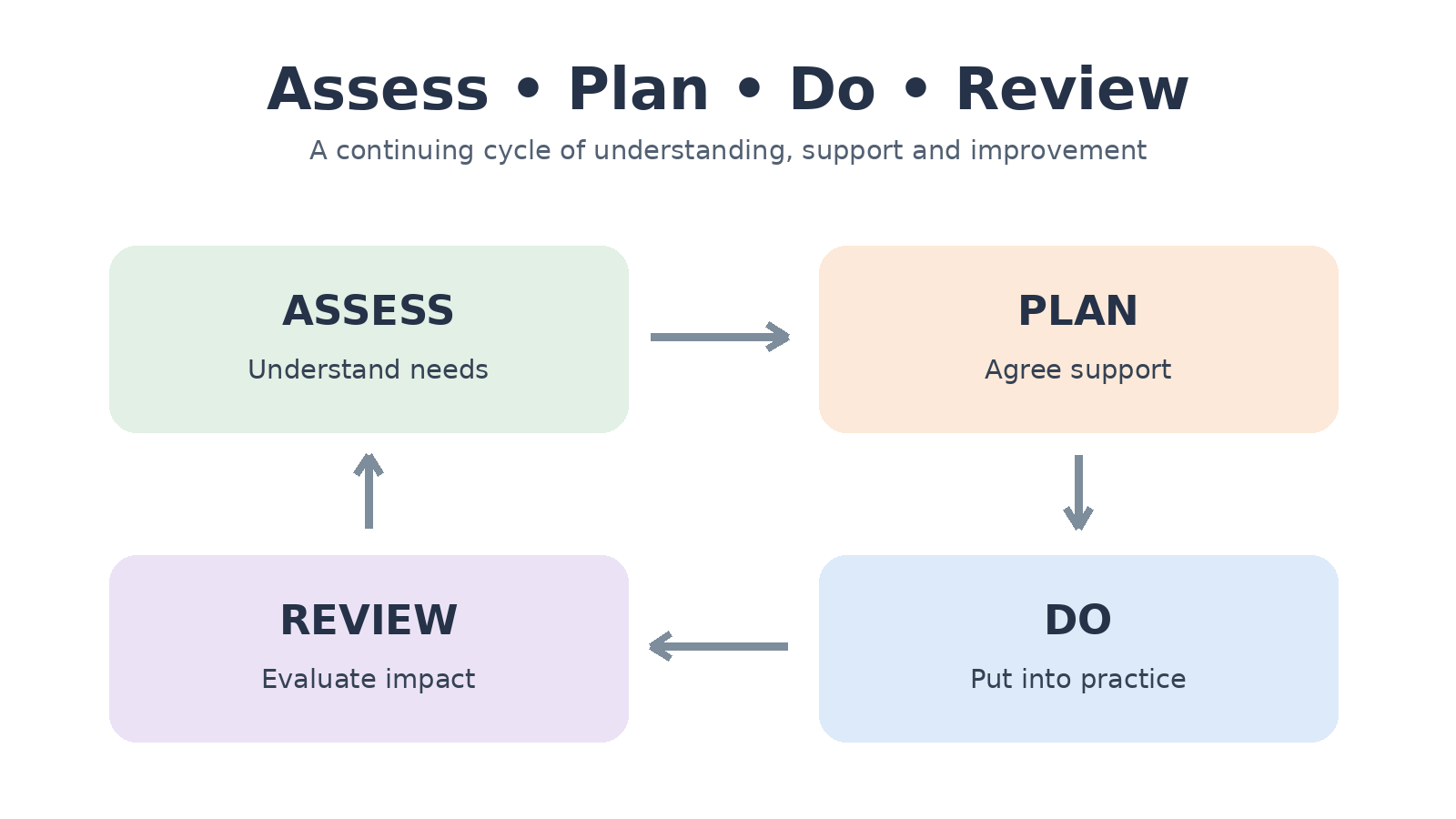
We use a graduated approach known as Assess, Plan, Do, Review. This is an ongoing process that helps us understand children's needs, provide support and evaluate how effectively it is working.
1. Assess
We gather information about a child's strengths, progress and difficulties. We consider observations, assessments and the views of the child and their family.
2. Plan
We agree what we want the child to achieve, what support or adjustments may help, who will provide them and when we will review progress.
3. Do
The agreed support is put into practice. The class teacher remains responsible for the child's learning, working with other staff and professionals where appropriate.
4. Review
We consider the child's progress, listen to feedback and evaluate what has helped. We then decide whether to continue, adapt or change the support.
This is a cycle, not a one-off assessment. As we learn more about a child, the support can be refined to reflect their changing needs. Families and children are important partners throughout this process, and we encourage parents and carers to share their observations, questions and concerns.
What Support Might My Child Receive?
Support will depend on the individual child's needs and may include additional teaching, targeted interventions, adapted resources, support with communication or emotional wellbeing or advice from specialist professionals.
Some children need support for a relatively short period. Others may require ongoing provision. Where appropriate, we may use individual planning documents to record particular outcomes and provision. Not every child with SEND will need the same type of plan. We aim to provide support that helps children make progress, develop confidence and independence, and participate meaningfully in school life.
What Is an EHCP?
An Education, Health and Care Plan (EHCP) is a legal document for children and young people whose special educational needs require provision to be secured through a statutory plan.
An EHCP describes the child's needs, the outcomes being sought and the special educational provision required. Not every child with SEND needs an EHCP. Many children have their needs met through SEN Support. Where an Education, Health and Care needs assessment may be appropriate, we can discuss the process with families and explain where to obtain further information and independent advice.
We recognise that understanding the EHCP process can sometimes feel complicated. Our SENDCo can help families understand the process and discuss the support available.
Families can also access free, impartial and confidential information, advice and support through Herefordshire and Worcestershire SENDIASS. This service is independent of the school and can help parents, carers and young people understand their rights and options. Click here to find out more about SENDIASS.
Working Together
Parents and carers know their children exceptionally well and their knowledge is an important part of understanding what support may be needed.
We provide opportunities to discuss children's progress and provision throughout the year, including at least three opportunities for consultation about SEN Support. We also value children's views and seek to involve them in decisions about their learning and support in ways that are appropriate to their age and needs.
If you have questions or concerns, please contact your child's class teacher or our SENDCo:
Jacqui Bennett — Assistant Headteacher (Inclusion) and SENDCo
Email: jbennett@bewdleyprimary.worcs.sch.uk
School telephone: 01299 403796
Every child's journey is different, and no family should feel they have to navigate concerns about their child's learning or development alone. You don't need to understand every SEND term or process before asking for help. Whether you have a question, need some advice or would like to discuss your child's needs, please get in touch. We are here to listen and work alongside you.